¡LA FOTO QUE CONMOVIÓ AL MUNDO! El Beso De La Vida Que Se Volvió Viral Décadas Después
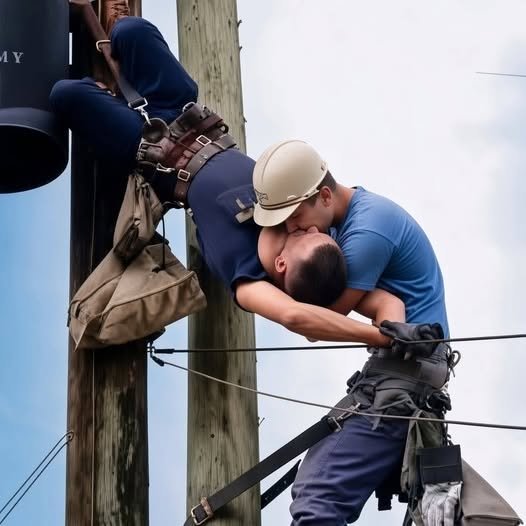
A powerful and iconic historical photograph capturing a utility worker administering mouth-to-mouth resuscitation to his unconscious colleague while hanging suspended high above the ground on a wooden utility pole has once again captured global attention across social media platforms, inspiring millions of viewers worldwide.
The image, widely known across photojournalism history as ‘The Kiss of Life,’ depicts utility lineman J.D. Thompson performing emergency CPR on fellow lineman Randall G. Champion after Champion accidentally came into contact with a high-voltage electrical line during routine maintenance work.
The Story Behind the Iconic Utility Pole Rescue
The historic event took place in July 1967 in Jacksonville, Florida, when utility linemen J.D. Thompson and Randall G. Champion were performing routine line maintenance work on power distribution lines. Champion accidentally touched one of the low-voltage lines at the top of the utility pole, receiving a severe electrical shock that immediately knocked him unconscious and stopped his breathing.
Suspended upside down by his safety harness high above the pavement, Champion remained trapped on the pole. Recognizing the extreme urgency of the situation, Thompson rushed up the utility pole, reached his unresponsive coworker, and immediately began performing mouth-to-mouth resuscitation while suspended mid-air.
Key moments that defined the miraculous emergency response include:
- Immediate Action Under Pressure: Thompson acted within seconds, climbing the pole without hesitation to reach his unconscious colleague before irreparable oxygen deprivation occurred.
- Suspended Cardiopulmonary Resuscitation: Performing CPR high above the ground while anchored only by safety straps required immense physical strength, dexterity, and emotional composure.
- Successful Revival: Thompson continued chest compression and mouth-to-mouth breathing until he felt a faint pulse, eventually lowering Champion safely to ground level where emergency medical personnel took over.
The Pulitzer Prize-Winning Photojournalism Legacy
The extraordinary photo was captured by photojournalist Rocco Morabito, a photographer for the Jacksonville Journal. Morabito was driving nearby when he heard screaming and witnessed the emergency unfolding on the utility line overhead. He quickly grabbed his camera from his vehicle and documented the split-second rescue operation.
Morabito’s photograph, titled ‘The Kiss of Life,’ was published in newspapers worldwide and earned the prestigious Pulitzer Prize for Spot News Photography in 1968. The image became a timeless symbol of heroism, brotherhood, and workplace safety dedication.
Workplace Safety and Electrical Rescue Protocols
The historical photograph played a significant role in highlighting the vital importance of safety protocols and emergency training for electrical utility workers globally. Modern electrical distribution and maintenance companies have established rigorous standards to protect field technicians from high-voltage hazards.
Essential emergency response protocols modern linemen undergo include:
- Pole-Top Rescue Training: Mandatory practical drills teaching utility technicians how to safely reach, revive, and lower injured personnel from elevated structures.
- Personal Protective Equipment (PPE): Utilization of insulated rubber gloves, arc flash suits, protective hard hats, and specialized climbing harnesses.
- De-Energization Verification: Rigorous testing procedures to ensure power lines are completely de-energized and grounded prior to initiating structural maintenance.
The Impact of Historical Imagery in the Social Media Era
In the modern digital landscape, historical photojournalism frequently resurfaces across social media platforms, reaching new generations of readers. When iconic photographs like ‘The Kiss of Life’ circulate online, they spark meaningful public discussions regarding industrial safety, heroism, and human solidarity.
Digital media experts note that historical photographs retain immense emotional resonance because they capture genuine, unscripted human experiences. Unlike staged contemporary media, authentic photojournalism offers a raw look into moments of extreme courage and vulnerability.
Long-Term Impact on Occupational Health Standards
Following the publication of the famous photograph, industrial safety organizations used the story of Thompson and Champion as a prime case study in technical safety training. The incident demonstrated that quick thinking combined with proper CPR knowledge directly saves lives under catastrophic working conditions.
Today, utility companies across North America and around the world require mandatory CPR and emergency response certification for all field personnel. The legacy of J.D. Thompson’s bravery continues to inspire emergency response guidelines and workplace safety standards across multiple industrial sectors.
The Psychological Dimensions of High-Stress Emergencies
Psychologists studying emergency response behaviors often cite the ‘Kiss of Life’ incident when analyzing how individuals react under intense life-or-death pressure. In high-stress situations, trained professionals rely heavily on repetitive practice, muscle memory, and strong interpersonal bonds to overcome immediate panic.
Thompson’s ability to remain focused while hanging upside down on a utility line illustrates the power of rigorous occupational preparation. When faced with an immediate crisis, his procedural instinct kicked in automatically, overcoming the inherent physiological panic that typically accompanies severe industrial accidents.
Photojournalism as a Catalyst for Public Awareness
Rocco Morabito’s Pulitzer Prize-winning image stands alongside other historical photographs that reshaped public consciousness. Great photojournalism does not simply document reality; it engages viewers emotionally, fostering empathy and inspiring lasting changes in safety policies and societal awareness.
Through the lens of Morabito’s camera, a localized industrial accident became a universal testament to human resilience. Decades after the incident occurred, the image continues to evoke awe, respect, and deep appreciation for frontline utility workers who risk their lives daily to maintain vital municipal infrastructure.
Industrial Evolution and the Modern Utility Worker
While modern utility line work relies heavily on advanced bucket trucks, automated line monitoring, and improved protective gear, the core hazards of electrical infrastructure work remain present. Technicians continue to operate in high-risk environments, facing challenging weather conditions, extreme heights, and high-voltage transmission equipment.
The ongoing circulation of ‘The Kiss of Life’ reminds society of the fundamental human labor required to maintain modern power grids. Behind every operational light switch, household appliance, and digital network is a dedicated workforce of linemen trained to keep communities connected safely.
The Enduring Power of Universal Human Stories
Ultimately, the story behind ‘The Kiss of Life’ transcends sports, politics, and technology. It remains a deeply human narrative about two colleagues whose mutual trust and specialized training resulted in a life-saving miracle high above the ground.
As social media networks continue to share and discuss this timeless image, the heroic actions of J.D. Thompson and the documentation by Rocco Morabito serve as an enduring reminder of human compassion, physical courage, and the life-saving impact of immediate action during critical emergencies.
Technological Advancements in High-Voltage Electrical Grid Maintenance
Since the era when J.D. Thompson and Randall G. Champion worked on municipal electrical poles, the field of power distribution engineering has undergone profound technological transformations. In the late 1960s, utility workers relied heavily on manual climbing gear, wooden utility poles, and basic leather safety harnesses. Today, state-of-the-art diagnostic instruments, aerial bucket lifts, and advanced synthetic materials protect utility technicians from environmental and electrical hazards.
Modern power grid management incorporates thermal imaging cameras, automated circuit reclosers, and remote sensing equipment that can detect line faults before technicians even step foot into the field. Drone technology is now routinely deployed to inspect high-voltage transmission lines, reducing the need for manual pole climbs in high-risk weather conditions or remote terrain.
Despite these technological leaps, physical intervention by skilled utility linemen remains indispensable. When extreme weather events like hurricanes, blizzards, or severe thunderstorms damage municipal electrical infrastructure, technicians must climb poles and manually restore power under dangerous conditions. The fundamental courage displayed in 1967 remains a core characteristic of the profession today.
The History of Emergency CPR and Resuscitation Science
The successful rescue of Randall G. Champion highlights an important milestone in the public adoption of cardiopulmonary resuscitation (CPR) and mouth-to-mouth ventilation. During the mid-20th century, mouth-to-mouth resuscitation was relatively new as a standardized public medical protocol, having been formally endorsed by medical associations only a decade prior to the 1967 incident.
Prior to the widespread teaching of mouth-to-mouth ventilation, manual compression techniques were less effective in maintaining oxygenation during respiratory arrest. The quick implementation of mouth-to-mouth breathing by J.D. Thompson provided essential oxygen to Champion’s brain, preventing irreversible neurological damage until emergency medical responders arrived on the scene.
In the decades following the incident, international health organizations have continually refined CPR guidelines. Modern training emphasizes high-quality chest compressions, automated external defibrillator (AED) usage, and widespread community education, empowering both professionals and bystanders to intervene effectively during cardiac and respiratory emergencies.